
Industrial Curtains vs. Permanent Walls: Which Is Right for Your Facility?
In warehousing and manufacturing spaces, the layout you start with is rarely the one you need six months later.
Production shifts. Storage needs change. New equipment gets added. And suddenly, the fixed walls that once made sense start getting in the way.
That’s where the decision between industrial curtains that provide temporary walls for warehouses and permanent walls becomes more than just a construction choice. It becomes an operational one.
Do you lock your space in place with a permanent build? Or do you keep things flexible with systems like industrial curtain walls that can adapt as your workflow evolves?
For facility managers, warehouse operators, and industrial teams, this choice often comes down to balancing warehouse structure with flexibility, cost with long-term control, and speed with durability.
Let’s break it down in a way that helps you choose what actually fits your operation.
Understanding the Two Approaches
Before comparing, it helps to define what we’re really talking about.
What Are Industrial Curtains?
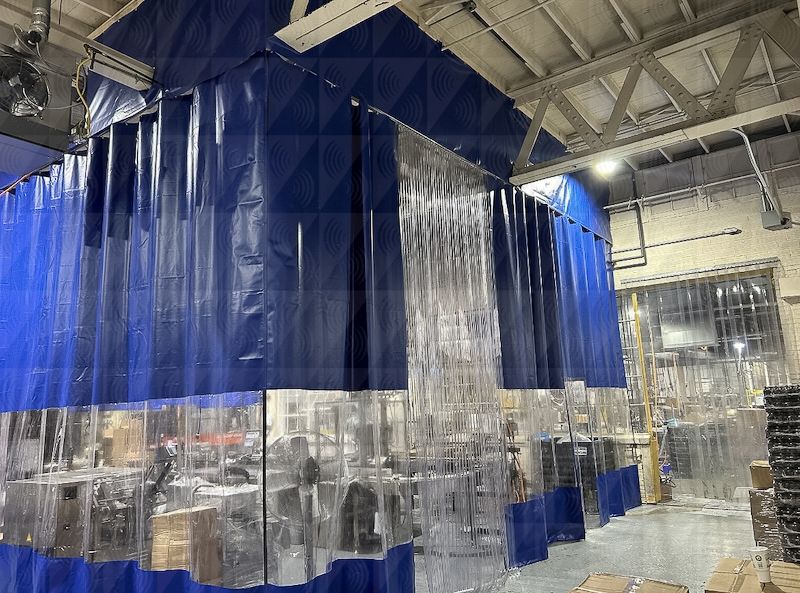
Industrial curtains are heavy-duty, flexible partition systems designed to divide, protect, and control space inside industrial environments. They are commonly made from reinforced vinyl and mounted on track systems or fixed hardware.
They can function as:
- Temporary warehouse walls
- Environmental barriers for dust, airflow, or moisture
- Zoned work areas inside larger facilities
- Flexible enclosures for changing workflows
In many cases, they operate as modular workspace partitions that can be opened, closed, or reconfigured as needed.
What Are Permanent Walls?
Permanent walls are fixed structural builds. They are typically made from drywall, metal framing, concrete block, or similar materials. Once installed, they are not designed to move or adapt without demolition or reconstruction.
They create:
- Fixed rooms or compartments
- Long-term structural separation
- Defined building layouts
Both solutions separate space. But they do it in very different ways.
Flexibility vs. Permanence: The Core Difference
The biggest distinction is simple: one adapts, the other doesn’t.
Industrial Curtains: Built for Change
Industrial curtain walls are designed with movement in mind to combat static and dynamic facility layout problems.
They allow you to:
- Expand or shrink work zones quickly
- Reconfigure layouts without construction downtime
- Open up space when not in use
- Adjust to seasonal or operational changes
This makes them especially useful for fast-moving operations like warehousing, manufacturing, and distribution.
In many cases, they function as temporary walls for warehouses that still deliver long-term durability.
Permanent Walls: Built for Stability
Permanent walls are best when the layout is final and unlikely to change. They offer a fixed structure that defines space clearly and consistently.
However, changes come at a cost:
- Demolition and rebuild work
- Operational downtime
- Higher long-term modification expenses
If your facility evolves often, that rigidity can become a limitation rather Cost Considerations: Upfront vs. Long-Term Value
Cost is often the first factor teams compare, but it’s not just about installation price.
Industrial Curtains and Cost Efficiency
Industrial curtains typically require:
- Less labor to install
- Minimal facility disruption
- Lower material costs compared to construction
They also support facility efficiency by reducing downtime during installation or reconfiguration.
Over time, they can help reduce expenses tied to:
- Heating and cooling loss between zones
- Inefficient use of large open spaces
- Constant rebuild or renovation cycles
Instead of committing to one layout forever, you invest in flexibility.
Permanent Walls and Long-Term Investment
Permanent walls can make sense when:
- Operating within a completely finalized layout
- Requiring long-term structural separation
- Expecting no operational changes
But any future modification usually requires additional construction budgets and planning cycles.
So while they may feel like a “one-time” build, they often become ongoing projects if your operations evolve.

Operational Efficiency and Workflow Impact
In warehouse and manufacturing environments, layout isn’t just about space. It’s about flow.
How Industrial Curtain Walls Improve Workflow
An industrial curtain wall helps improve workflow by creating adaptable zones inside a larger facility.
They support:
- Clear separation between processes
- Faster workflow adjustments
- Better use of unused or underutilized space
- Cleaner traffic flow for equipment and staff
Because they are flexible, they can grow with your operation instead of restricting it.
Many facilities use industrial partitions to separate:
- Production and storage areas
- Clean and dirty processes
- Active and staging zones
How Permanent Walls Shape Workflow
Permanent walls enforce structure. That can be helpful in highly stable environments.
But they can also:
- Limit movement between zones
- Reduce visibility across departments
- Restrict future layout changes
- Require workarounds as operations evolve
If your workflow is dynamic, fixed walls can start to feel like obstacles instead of support systems.
Environmental Control and Facility Performance
Another major factor is how each option handles environmental conditions.
Industrial Curtains for Controlled Environments
Industrial curtains are often used to help manage:
- Airflow between zones
- Temperature differences
- Dust and airborne particles
- Moisture exposure in open areas
By creating flexible barriers, they support better environmental separation without sealing off the entire facility.
Industrial partitions can improve facility efficiency by helping reduce unnecessary energy loss between large open spaces.
Permanent Walls and Full Separation
Permanent walls offer complete separation between spaces. That can be useful when strict containment is needed.
However, full enclosure can sometimes:
- Reduce airflow flexibility
- Require more intensive HVAC zoning
- Limit adaptability for changing environmental needs
The tradeoff is clear: stronger separation, less flexibility.
Space Optimization: Making Every Square Foot Count
Space is expensive. Using it efficiently matters.
Industrial Curtain Walls for Space Optimization
With industrial partitions, you can:
- Turn one large area into multiple zones
- Reclaim underused corners or bays
- Create seasonal or temporary work areas
- Adjust layouts without renovation
They are especially effective as warehouse curtain wall systems in distribution centers where storage and staging needs shift constantly.
This is where modular workspace partitions really shine. You’re not locked into one layout. You’re working with a system that evolves with demand.
Permanent Walls and Fixed Layouts
Permanent walls divide space permanently. That can help with organization, but it also locks in:
- Fixed square footage allocations
- Limited flexibility for expansion
- Less efficient use of fluctuating space needs
If your inventory or production volume changes often, fixed layouts can lead to wasted space.
Installation Speed and Downtime
Time matters in industrial operations. Every hour of downtime has a cost.
Industrial Curtains Install Faster
One of the biggest advantages of these curtains is speed.
They can typically be:
- Installed quickly with minimal disruption
- Added to existing structures
- Reconfigured without shutting down operations
That means your facility keeps moving while improvements happen.
Permanent Walls Require Construction Time
Permanent builds often involve:
- Permits and planning
- Construction crews
- Longer installation timelines
- Operational shutdowns or rerouting
Even small wall additions can create noticeable disruption.
When to Choose Industrial Curtains
You’ll likely benefit from modular workspace partitions if your facility needs:
- Flexible layouts that change over time
- Scalable production or storage areas
- Temporary zoning without construction
- Better airflow or environmental control
- Faster installation with minimal downtime
They are especially effective in:
- Warehouses and distribution centers
- Manufacturing facilities with shifting workflows
- Facilities testing new operational layouts
- Spaces needing frequent reconfiguration
In these environments, warehouse curtain walls often outperform fixed builds simply because they adapt.
When Permanent Walls Make More Sense
Permanent walls are a better fit when you have:
- Fully finalized layouts
- A need for long-term structural separation
- No expectation of reconfiguration
- Building codes or safety requirements that demand fixed construction
In these cases, permanence provides stability and clarity.
The Hybrid Approach: Best of Both Worlds
Many modern facilities don’t choose one or the other. They combine both.
You might see:
- Permanent walls for core infrastructure
- Industrial curtains for flexible zones
- Mixed-use layouts that shift over time
This hybrid model supports both stability and adaptability, especially in growing operations.
FAQs
Are industrial curtains permanent or temporary?
They can be either. Most systems are designed to be flexible, meaning they can remain in place long term but still be reconfigured when needed.
How durable are industrial curtain walls?
They are made from reinforced materials designed for industrial environments. With proper care, they can perform reliably for years.
Can industrial curtains replace full construction?
In many cases, yes. Especially when the goal is separation, environmental control, or zoning rather than full structural enclosure.
Do they help with facility efficiency?
Yes. By improving layout flexibility and reducing wasted space, they often support better overall facility efficiency.
Plan Smarter Facility Layouts With Redcon
Choosing between modular workspace partitions and permanent walls comes down to how your facility needs to perform today and how much flexibility you want tomorrow.
If your operation is evolving, growing, or constantly adjusting workflows, rigid construction can slow you down. Flexible systems like Super-Vision curtain walls & partition systems and Privacy Series industrial curtain walls give you room to adapt without starting over.
At Redcon, we design systems around real facility use, not theoretical layouts. That means helping you identify where you need separation, where you need flexibility, and how to build a setup that supports long-term efficiency.
If you’re exploring options for your space, we can help you map it out. Request a facility assessment today!