
Noise Reduction Curtains for Factories: What Works (and What Doesn’t)
Factories are built around productivity, but manufacturing equipment can generate significant noise during the workday. Presses, conveyors, compressors, CNC machines, welding operations, and other equipment can create an environment where excessive sound affects communication, concentration, comfort, and workplace safety. For facilities looking for practical ways to address these challenges, industrial noise curtains can provide a flexible approach to managing sound without permanently rebuilding the facility.
However, not every curtain or sound-control strategy delivers the same results. Understanding how acoustic materials work, where they should be installed, and what they can realistically accomplish is essential to effective factory noise control.
What Works: Targeted Acoustic Barriers
One of the most effective applications for industrial noise curtains is creating a barrier between a noisy operation and surrounding work areas. Rather than attempting to eliminate sound throughout an entire building, curtains can isolate specific sources and limit the amount of noise that travels into adjacent spaces.
This targeted approach makes acoustic curtain walls particularly useful around machinery, production cells, testing areas, and fabrication stations. By positioning a sound-control barrier close to the source, facilities can reduce direct sound transmission while maintaining access to equipment.
The construction of the barrier matters. Effective soundproof curtains industrial applications typically use dense, heavy materials designed to impede sound transmission. Heavier curtain assemblies can provide substantially more acoustic mass than lightweight fabrics, making them better suited to demanding manufacturing environments.
What Works: Mass and Layered Construction
When evaluating soundproof curtains industrial solutions, material density is one of the most important considerations. Sound behaves differently depending on frequency, and a thin fabric curtain cannot be expected to perform like a purpose-built acoustic barrier.
Mass loaded vinyl curtains, for example, use a dense material specifically designed to add mass to a flexible barrier. This added mass can help reduce the transmission of airborne sound through the curtain assembly.
In some applications, mass loaded vinyl curtains can be incorporated into multilayer systems that combine sound-blocking and sound-absorbing properties. This approach can make noise reduction systems more effective because different layers address different aspects of the acoustic problem.
The objective is not simply to hang fabric around a machine. Effective industrial sound barriers should be selected according to the source of the noise, the surrounding environment, the desired reduction, and the physical limitations of the facility.
What Doesn’t: Treating Curtains Like Soundproof Rooms
One common misconception is that installing a curtain automatically makes an area soundproof. In reality, industrial noise curtains are generally intended to reduce or contain sound, not create complete silence.
Sound can travel through gaps, ceilings, floors, ventilation systems, doors, and other pathways. If a curtain wall has large openings around the top, bottom, or sides, sound can simply travel around the barrier. That is why installation and configuration are just as important as the curtain material itself.
Similarly, placing a single lightweight curtain several feet away from a noisy machine may provide limited results. Effective factory noise control requires consideration of how sound moves through the entire space.
Facilities should also avoid assuming that one solution will work equally well for every frequency. Low-frequency noise can be especially difficult to control and may require additional engineering measures beyond curtains.
What Works: Flexible Industrial Curtain Systems
Permanent construction is not always practical in a manufacturing environment. Production layouts change, equipment moves, and facilities need to maintain access for employees, forklifts, maintenance personnel, and material handling.
This is where flexible acoustic curtain walls can offer an advantage. Unlike permanent walls, industrial curtain systems can be configured around specific areas and adjusted as operational needs change. They can define work zones while helping control sound, dust, airflow, and other environmental conditions.
For facilities with frequently changing layouts, flexible industrial sound barriers can provide an alternative to costly permanent construction. They can help create enclosed or semi-enclosed production areas without sacrificing the adaptability that modern manufacturing environments require.
Redcon Industrial Supplies: Industrial Curtains Built for Facilities
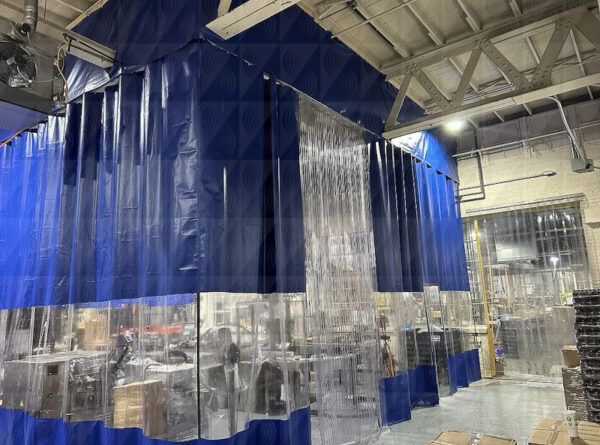
Redcon Industrial Supplies provides industrial curtain and curtain wall solutions designed for warehouses and manufacturing facilities. Its industrial curtain products can be used to create defined spaces within larger facilities while supporting practical needs such as environmental separation, workflow organization, and noise management.
A major benefit of industrial curtain systems is their flexibility. Instead of constructing permanent walls whenever a facility needs to divide an area, curtains can create modular workspaces that can be configured or repositioned as requirements change. This makes them useful for manufacturing operations where production processes and equipment layouts evolve over time.
For applications involving sound, the same flexibility can support noise reduction systems by allowing facilities to isolate specific operations rather than attempting to acoustically treat an entire building. Properly configured industrial noise curtains can help contain sound around designated work areas while preserving visibility and access.
Redcon’s industrial curtain approach can also help facilities address multiple operational requirements with a single modular system. Depending on the application, curtain walls from our Super-Vision line can help separate workspaces, control airflow, contain dust and debris, and establish more organized production zones. This makes them a practical component of broader factory noise control and facility management strategies.
What Doesn’t: Using Noise Curtains as the Only Solution
Curtains should not be viewed as a substitute for comprehensive acoustic engineering when noise levels are severe. If a facility has extremely loud machinery, significant structural vibration, or widespread low-frequency noise, additional measures may be necessary.
These can include equipment enclosures, vibration isolation, acoustic ceiling treatments, absorptive wall materials, equipment maintenance, or modifications to the machinery itself. In those circumstances, soundproof curtains industrial solutions can be one layer within a larger noise-control strategy rather than the entire solution.
The best results typically come from identifying the primary noise sources first and then combining appropriate industrial sound barriers with other controls.
Building a Better Factory Noise Strategy
Effective noise reduction starts with realistic expectations. Industrial noise curtains can be highly useful when they are selected for the application, installed correctly, and integrated into a broader control strategy. They are particularly valuable when a facility needs a flexible way to isolate noisy operations without permanently altering its floor plan.
For demanding applications, soundproof curtains industrial systems should be evaluated based on material construction, coverage, placement, gaps, noise frequencies, and the overall facility layout. When combined with other noise reduction systems, they can contribute to a more controlled and comfortable manufacturing environment.
Ultimately, successful factory noise control is not about finding one product that solves every acoustic problem. It is about matching the right combination of barriers, materials, equipment controls, and facility design to the source of the noise. With flexible industrial curtain solutions from Redcon Industrial Supplies, manufacturers can take a practical step toward better sound management while maintaining the adaptability their operations require. Use our Request a Quote form and our team can help you create a noise barrier system that meets your needs.
Frequently Asked Questions (FAQs)
1. Do industrial noise curtains actually reduce factory noise?
Yes, industrial noise curtains can help reduce the amount of airborne sound traveling from noisy machinery or production areas into surrounding workspaces. Their effectiveness depends on factors such as curtain construction, material density, placement, coverage, gaps, and the type and frequency of the noise. They generally work best when positioned strategically around a specific noise source rather than being expected to soundproof an entire factory.
2. What is the difference between sound-blocking and sound-absorbing curtains?
Sound-blocking materials are designed to reduce the transmission of sound from one area to another, while sound-absorbing materials help reduce reflected sound within a space. Some industrial noise reduction systems combine both approaches using layered construction. Understanding whether the primary problem is sound transmission, excessive reverberation, or both can help determine the appropriate acoustic solution.
3. Are mass loaded vinyl curtains effective for industrial noise control?
Mass loaded vinyl curtains can be useful for reducing airborne sound transmission because their density adds mass to the barrier. In industrial applications, mass loaded vinyl may also be incorporated into layered acoustic curtain systems. Performance still depends on the overall system design, including placement, coverage, openings, and the characteristics of the noise source.
4. Where should industrial noise curtains be installed for the best results?
Industrial noise curtains are generally most effective when installed close to the machinery or operation generating the sound. Curtains can be configured around production cells, testing areas, fabrication stations, compressors, or other noisy equipment to help limit sound transmission into neighboring work areas. Facility layout, equipment access, ventilation, and material-handling routes should all be considered when designing the enclosure. Use our Request a Quote form to share your facility details and we can help you.
5. Can industrial noise curtains replace permanent acoustic walls?
In some applications, industrial noise curtains can provide a flexible alternative to permanent walls, particularly when equipment or production layouts change frequently. They can be opened, repositioned, or reconfigured as facility needs evolve. However, curtains are not appropriate for every acoustic problem. Facilities experiencing severe noise, structural vibration, or difficult low-frequency sound may require additional engineering controls as part of a broader factory noise-control strategy.