
From Open Floor To Controlled Zones: How Industrial Curtains Transform Facilities
Industrial facilities rarely keep the same layout for very long. As production needs change, equipment is added, workflows evolve, and companies look for ways to use existing square footage more efficiently. What once worked as a wide-open floor plan may eventually become difficult to manage, creating a need for better separation between work zones without the cost and permanence of conventional construction.
This is where industrial curtains can be a game changer. Rather than building permanent walls, facilities can use flexible barriers to create defined zones, improve workflow, contain specific operations, and adapt the layout as needs change. For manufacturers, warehouses, automotive shops, and other industrial environments, this approach provides a practical path from an open floor to a more controlled facility.
Why Facility Zoning Matters
Effective facility zoning is about more than dividing a building into sections. It is about organizing space according to how work is actually performed. Production, assembly, storage, maintenance, shipping, and specialized operations may each have different requirements.
Strategically placed industrial partitions can establish these boundaries without disrupting the overall facility. A curtain can separate a dusty process from a clean work area, define a temporary production zone, or create a dedicated workspace around equipment. Because the barrier can be opened, closed, moved, or reconfigured, it supports changing operational requirements.
This flexibility also makes industrial curtains valuable for companies pursuing more adaptable industrial layout design. Instead of treating the facility layout as permanent, businesses can modify their space as processes and priorities change.
Creating Flexible Work Areas
One of the biggest advantages of industrial partitions is their ability to create modular workspaces. A modular approach allows companies to establish dedicated areas without committing to permanent construction.
For example, a manufacturer could create a temporary assembly area during a production expansion, establish a maintenance enclosure around machinery, or separate a project area from normal traffic. When the project ends, the industrial curtains can be opened or reconfigured rather than leaving a permanent structure behind.
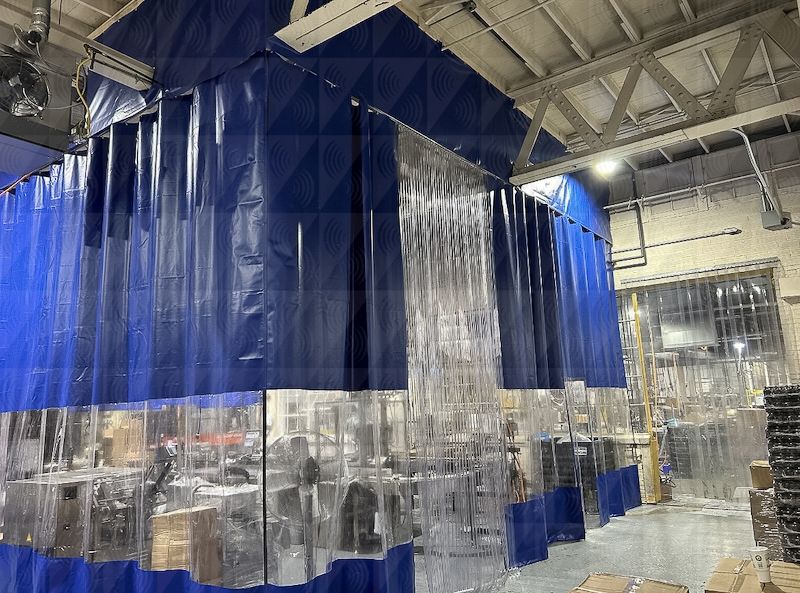
This approach can also improve warehouse partitions. Instead of installing rigid walls that permanently consume valuable floor space, track-mounted curtain systems can create separation while preserving access and visibility. The result is a warehouse environment that can respond more easily to inventory, staffing, and operational changes.
Redcon Industrial Supplies Industrial Curtain Options
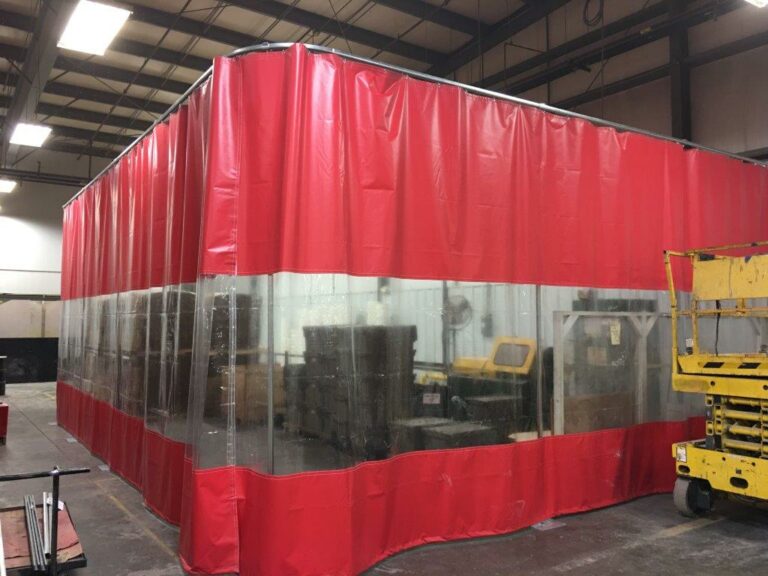
Redcon Industrial Supplies offers several curtain solutions designed for different facility requirements. Its automotive curtains, for example, can create enclosed, see-through workspaces for applications such as spot painting, detailing, grinding, and cutting. These systems help contain overspray, dust, and sparks while allowing the workspace to remain accessible when needed.
The automotive systems are available with track and hardware configurations designed for smooth movement and secure closure. Options include reinforced vinyl materials, a zinc-plated chain bottom hem for added stability, and heavy-duty Velcro® strips that help create a tighter seal. Multiple partition kits and custom configurations are available as well.
For exterior applications, Redcon’s outdoor curtains provide another way to establish controlled areas. Constructed from high-strength vinyl, these curtains are designed to help protect workspaces from rain, snow, wind, dust, and other environmental conditions. Track-mounted glide systems make them flexible, while Velcro-sealed closures provide additional protection.
Together, these options demonstrate how curtain wall systems can be tailored to different environments rather than functioning as a one-size-fits-all barrier. Whether the goal is containing an industrial process or protecting an outdoor workspace, the right curtain configuration can provide separation while maintaining flexibility.
Improving Efficiency Without Permanent Construction
Traditional construction can be expensive, disruptive, and difficult to reverse. Industrial partitions provide another option for businesses that need functional separation without permanently rebuilding their facilities.
For companies evaluating facility zoning, this can be particularly valuable. A curtain system can establish boundaries around a production process while allowing employees, equipment, and materials to move through the facility as required. It can also support modular workspaces that change with production demands.
The same principle applies to warehouse partitions. When storage requirements or material flows change, flexible barriers can be repositioned instead of demolished and rebuilt. This makes industrial layout design more responsive while helping businesses get more utility from existing square footage.
Designing a Facility That Can Adapt
The modern industrial facility needs to accommodate change. New equipment, different production volumes, safety requirements, and seasonal operations can all affect how space should be organized. Permanent walls may solve one problem while creating another if the operation changes later.
Industrial curtains offer a more adaptable alternative. Used as part of a thoughtful industrial layout design, they can define work areas, improve containment, establish controlled zones, and support changing workflows without sacrificing the openness of the facility.
For businesses looking to improve facility zoning, curtain wall systems provide a practical way to introduce separation where it is needed. Combined with flexible modular workspaces and strategically placed warehouse partitions, they can help transform an open industrial floor into a more organized, efficient, and adaptable environment.
The goal is not simply to add barriers. It is to create a facility that works better today while remaining flexible for whatever tomorrow may bring. Redcon Industrial Supplies’ range of industrial curtains and industrial partitions gives businesses a flexible tool for accomplishing exactly that. Use our Request a Quote form to share your project details and allow us to suggest what would best suit your facility’s needs.

Frequently Asked Questions (FAQs)
1. How can industrial curtains improve facility layout and workflow?
Industrial curtains can divide an open facility into defined work zones based on how different processes operate. They can separate production, assembly, storage, maintenance, or specialized work areas while preserving access for employees, equipment, and materials. This allows facility managers to organize workflows without permanently changing the building.
2. Are industrial curtains a good alternative to permanent warehouse partitions?
Industrial curtains can be a practical alternative when a facility needs separation but also expects its layout to change. Unlike permanent walls, track-mounted curtain systems can be opened, closed, or reconfigured as operational requirements evolve. This flexibility can be especially valuable in warehouses and manufacturing facilities where inventory, equipment, or production needs change frequently.
3. What types of controlled zones can industrial curtains create?
Industrial curtains can be used to establish production areas, temporary assembly spaces, maintenance enclosures, automotive work areas, storage zones, and other modular workspaces. Depending on the curtain system selected, they can also help contain dust, overspray, sparks, or environmental conditions associated with a particular operation.
4. Can industrial curtain systems be reconfigured if a facility’s needs change?
Yes. Flexibility is one of the primary advantages of industrial curtain systems. Track-mounted curtains can allow facilities to modify access or separation as workflows change, while modular configurations can provide an alternative to demolishing and rebuilding permanent partitions. The appropriate level of reconfiguration will depend on the curtain system, track layout, mounting method, and facility design.
5. How do I determine where industrial partitions should be installed in my facility?
Start by evaluating how people, materials, equipment, and processes move through the facility. Look for areas where overlapping operations, environmental conditions, or inefficient use of space are creating problems. From there, industrial partitions can be planned around the facility’s workflow, access requirements, equipment placement, and future needs rather than simply dividing the floor into arbitrary sections. Use our Request a Quote form and we can help you with this planning.