
Welding Curtain Walls for Large Facilities: What You Need to Know
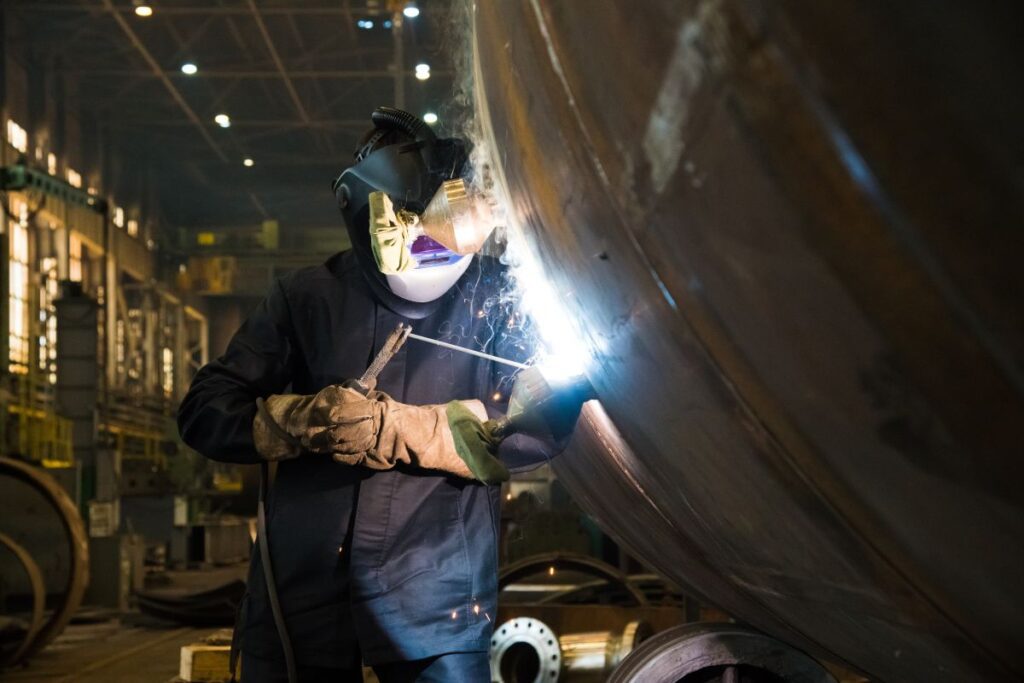
Large fabrication shops, manufacturing plants, repair facilities, and other industrial environments often have welding operations taking place alongside assembly, machining, storage, inspection, and material handling. In these settings, controlling the hazards created by welding requires more than a small portable screen. Specialty welding curtain walls can create dedicated work zones that help protect nearby personnel while allowing the rest of the facility and workers to keep operations running smoothly.
Why Large Facilities Need Welding Curtain Walls
The scale of a facility changes how welding hazards must be managed. Arc radiation, sparks, spatter, and debris can reach adjacent work areas, while an improperly planned enclosure can interfere with visibility, access, and ventilation. This has a direct impact on workers’ health and safety, as well as overall efficiency.
Welding curtains provide a way to establish boundaries around hot-work areas. Welding curtain walls can span substantial openings, separate stations, or create temporary work zones. Unlike permanent construction, they can be configured around changing production requirements.
This flexibility makes welding partitions particularly useful when a facility needs to balance safety with productivity. Rather than dedicating an entire room to welding, operations teams can use industrial curtain walls to define controlled zones within an existing floor plan while keeping employees at other stations safe.
What To Consider When Designing a Welding Area
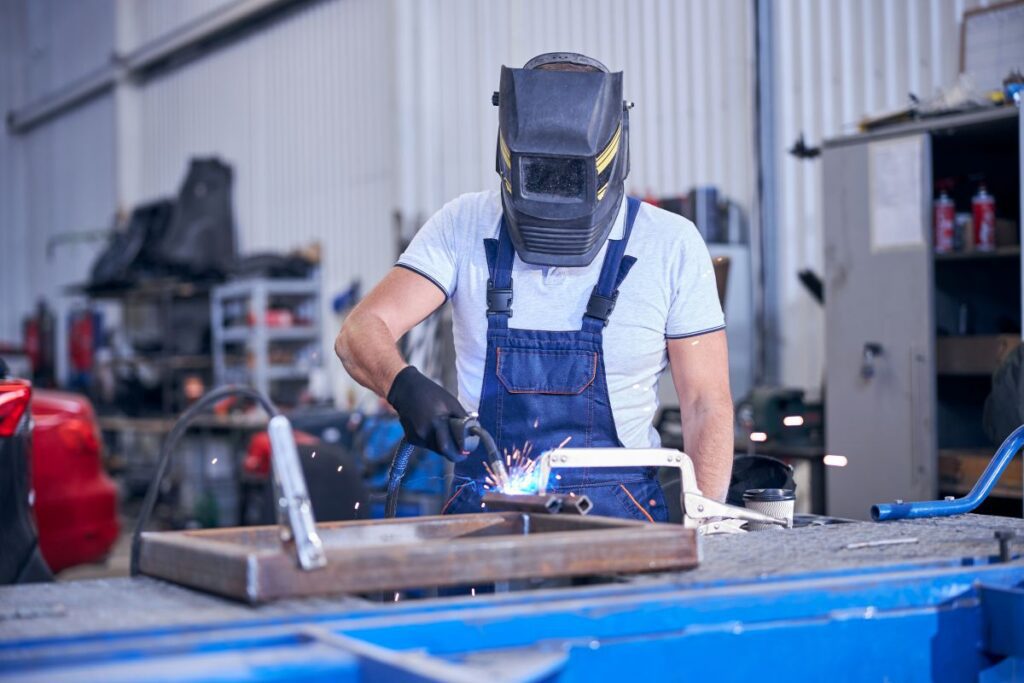
A successful welding enclosure starts with the facility itself. Before selecting a system, consider the number of welders, the size and location of workpieces, ceiling height, traffic patterns, material movement, and the proximity of other employees.
Ventilation is also critical. Curtains should not be treated as a substitute for appropriate mechanical or local exhaust ventilation. OSHA requires welding areas to be arranged so employees are protected from arc rays, while proper ventilation controls hazardous fumes and gases. Screens and enclosures must be planned so they do not unnecessarily restrict airflow.
The right configuration also supports large facility safety. A fully opaque barrier can provide containment, while semi-transparent welding curtains can allow supervisors to monitor operations without entering the work zone. The level of visibility required depends on the application, supervision needs, and hazards present.
Welding Enclosures Without Permanent Construction
For facilities that frequently change their layouts, welding enclosures can provide a more adaptable alternative to framed walls. Track-mounted curtains can be opened, closed, and repositioned as equipment or production processes change.
This approach is especially useful for large-scale fabrication and large facility safety. Oversized components may not remain in one location, and fixed walls can become obstacles to cranes, forklifts, and other material-handling equipment. Modular welding partitions can move with the needs of the operation, even daily or hourly depending on the facility’s work schedule.
A well-designed system can also improve workflow. By creating defined welding zones, fabrication teams can reduce unnecessary interruptions and keep surrounding operations moving.
Features That Matter in Large-Facility Applications
When comparing welding curtains and welding curtain systems, look beyond the curtain material itself. The supporting track, hardware, panel configuration, and mounting method all affect usability and durability.
For large facilities, modular steel track systems can provide a practical way to create long runs of curtains or multiple connected sections. Smooth-glide hardware makes it easier for employees to open and reposition panels when access is required. Custom dimensions are also important when a facility has unusual ceiling heights, irregular equipment layouts, or large work areas.
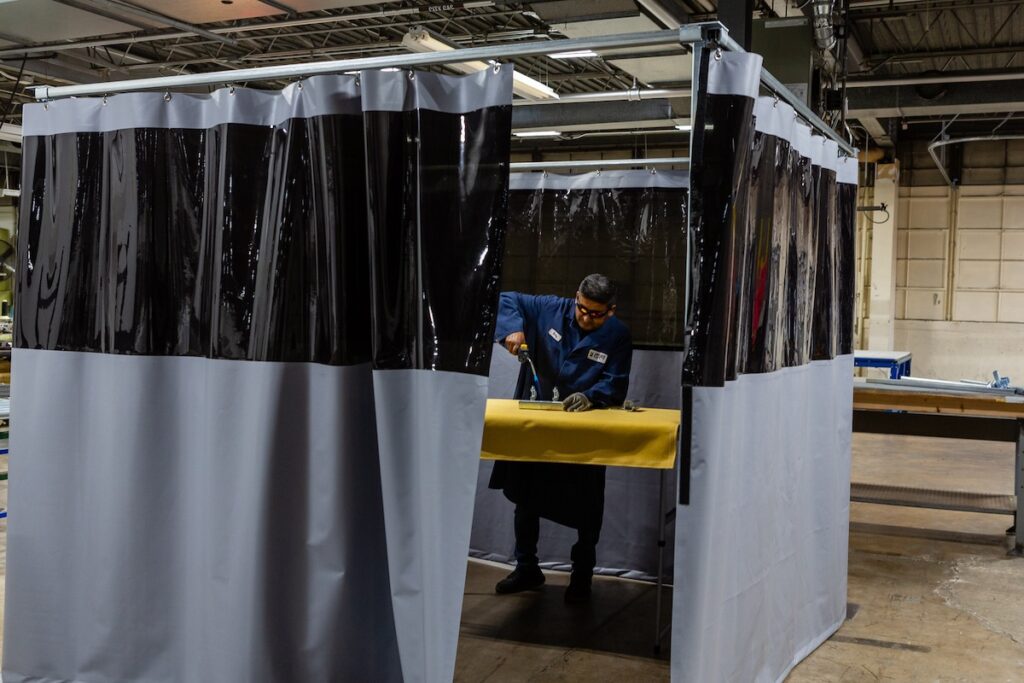
Industrial curtain walls should be configured to match the application. Opaque upper and lower sections can support containment, while semi-transparent center panels can preserve visibility. Fully opaque options may be appropriate where additional visual separation is needed. Free-standing, four-sided systems can also create temporary welding stations without the hassle and expense of adding permanent walls.
These features allow industrial curtain walls to function as more than simple barriers. They become configurable components of a facility’s safety and workflow strategy.
Redcon’s Weld-Vision Series: Built for Flexibility
Redcon Industrial Supplies’ Weld-Vision Series is designed for manufacturing, fabrication, automotive, aerospace, marine, repair, maintenance, and training environments. The system combines flash-blocking vinyl panels with practical fabrication safety features to create dedicated welding zones.
One of the most useful features is the semi-transparent viewing panel. It allows supervisors and nearby personnel to maintain visibility of the operation while reducing exposure to welding arc radiation. The system uses opaque upper and lower sections for containment, with optional fully opaque configurations.
The Weld-Vision Series is available in 8, 10, and 12-foot configurations and can be customized to accommodate facility dimensions, irregular layouts, ceiling heights, access points, and sealing requirements. Smooth-glide roller hooks and modular steel tracks make the panels easier to reposition as workflows change.
For facilities that need temporary or mobile stations, Redcon Industrial Supplies also offers free-standing, four-sided welding enclosures. This flexibility can help organizations adapt their fabrication safety systems without committing to permanent construction.
Building a Safer, More Productive Facility
Welding curtains support a broader safety plan. Effective welding safety is not simply about placing a barrier around an arc. The enclosure needs to work with ventilation, PPE, fire prevention practices, traffic flow, material handling, and the facility’s safety program. OSHA guidance emphasizes shielding employees from direct arc rays while maintaining appropriate ventilation and other protections.
When those elements are considered together, welding curtains can help create safer and more controlled work environments.
For large facilities, the goal is to create effective welding zones that support people, equipment, and production. With the right combination of welding curtain walls, welding partitions, ventilation, and workplace procedures, companies can improve large facility safety while maintaining operational flexibility.
Redcon Industrial Supplies can help facilities evaluate their layouts and develop welding curtain systems around specific processes, dimensions, and access requirements. Whether the need is a single enclosed workstation or a large network of interconnected welding areas, a properly planned curtain solution can become an important part of a comprehensive fabrication safety systems strategy. Share the specifications of your facility and where you are looking to create a safer welding area using our request a quote form and we’ll reach out to talk through your project.
Frequently Asked Questions (FAQs)
1. What is the difference between welding curtains, welding screens, and welding curtain walls?
Welding curtains are flexible barriers designed to help shield surrounding workers and work areas from welding hazards such as arc radiation, sparks, and spatter. Welding screens are typically smaller or portable barriers used around individual workstations. Welding curtain walls can span larger areas or be configured into interconnected systems, making them particularly useful for manufacturing plants, fabrication shops, and other large facilities with multiple welding zones.
2. How do I determine what size welding curtain wall my facility needs?
The right size depends on the welding area, ceiling height, equipment dimensions, number of welding stations, employee traffic patterns, and how materials move through the facility. Large or irregular spaces may require custom welding partitions rather than standard-size screens. Redcon can design curtain wall systems around facility dimensions, access points, equipment placement, and operational requirements, starting with our Request an Estimate form.
3. Can welding curtain walls be moved or reconfigured as production needs change?
Yes. Track-mounted welding curtain walls can be opened, closed, and repositioned as workflows change. This makes them particularly useful for facilities handling oversized components, changing production lines, or spaces that serve multiple functions. Free-standing welding enclosures can provide another option when a facility needs a temporary or mobile welding station.
4. Do welding curtains replace ventilation or personal protective equipment?
No. Welding curtains are one component of a broader welding safety system. They should be used alongside appropriate PPE, ventilation, fire-prevention practices, and other workplace safety measures. Curtains can help shield nearby personnel from arc radiation and contain sparks and spatter, but they should not interfere with the ventilation needed to control welding fumes and gases.
5. Should I choose opaque or semi-transparent welding curtains?
The best choice depends on the facility and how the welding area needs to function. Semi-transparent welding curtains can allow supervisors to maintain visibility into a welding zone while helping reduce exposure to welding arc radiation. Fully opaque curtains provide greater visual separation. Facilities should consider supervision requirements, surrounding operations, the welding process, and applicable safety requirements when selecting a configuration.