
Hanging vs. Roll-Up Welding Curtains: Which System Works Best?
Welding areas need more than a barrier between a torch and the rest of the shop. They need a practical containment strategy that limits exposure to hazards like arc flash, sparks, spatter, and debris while allowing production to continue. For many facilities, the choice comes down to hanging welding curtains or roll up welding curtains. Both approaches can help create controlled welding areas, but the right option depends on workflow, available space, access requirements, and how often the welding area changes.
In this article, we’ll explain the differences in style and use between the types of curtains, and highlight the features of the Weld-Vision Series curtains Redcon has designed just for this purpose.
Understanding the Difference
Hanging welding curtains are suspended from a fixed support or track and typically remain in place as a dedicated barrier. They are well suited to permanent or semi-permanent welding zones where operators need consistent enclosure around welding workstations. Because the curtain can slide along a track, workers can open the area for access without removing the system.
Roll up welding curtains use a retractable mechanism to raise the curtain when the welding area is not in use. This design can be useful where floor space or frequent access is a concern. Instead of moving a panel across a track, operators roll the curtain upward, creating an open passage when needed.
Neither design is automatically better. The best welding curtain systems are selected according to how the space is used, how frequently welding occurs, and how quickly the barrier needs to move.
When Hanging Curtains Make Sense
The biggest advantage of hanging welding curtains is straightforward containment. A curtain suspended from a track can define a welding zone while still allowing the enclosure to open when materials, equipment, or personnel need to pass through. This makes hanging welding curtains particularly useful in fabrication shops with repeatable workflows.
They also work well when a facility wants flexible welding screens that can be repositioned along a track. Multiple panels can create larger enclosures, separate adjacent operations, or establish individual welding workstations. For facilities that expect layouts to evolve, flexible welding partitions provide containment without the cost and permanence of a constructed wall.
When Roll-Up Curtains Make Sense
Roll up welding curtains are most useful when the barrier needs to retract quickly between jobs. A retractable curtain can keep an opening clear when welding is not underway, simplifying material handling and traffic flow. This can be especially valuable where forklifts, carts, or large components regularly move through the same opening.
Roll up welding curtains can also be an attractive option where a facility wants a cleaner, less obstructed footprint. However, retractable hardware, mounting requirements, and operating height should be evaluated before selecting the system. The curtain still needs appropriate coverage and should be integrated into the facility’s broader safety plan.
Comparing the Two Systems
When comparing hanging welding curtains with roll up welding curtains, it’s smart to think about how often your facility will be using them. A dedicated welding cell that operates throughout the day may benefit from a track-mounted configuration that is easy to slide open and closed. A welding area used intermittently may benefit from a retractable design that stays out of the way when inactive.
Next, consider how accessible the area needs to be. Hanging welding curtains can create wide openings by sliding panels aside, while roll up welding curtains open vertically. The physical layout of the facility often determines which motion is more practical.
Finally, consider scalability. Modular welding curtain systems can be expanded or reconfigured as production changes. For facilities with changing workflows, industrial safety curtains can provide a more adaptable alternative to permanent construction. Properly designed flexible welding partitions can also accommodate changing work zones without major facility modifications.
Redcon Weld-Vision Series: Built for Flexible Welding Zones
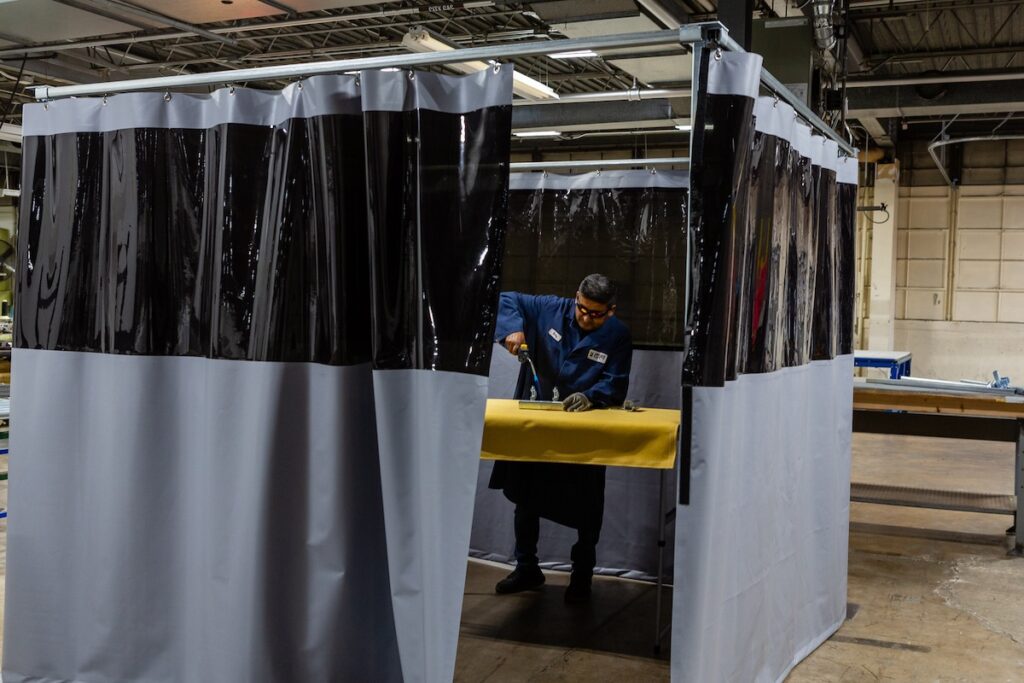
Redcon Industrial Supplies’ Weld-Vision Series is designed for facilities that need containment, visibility, and flexibility in one system. The series uses flash-blocking vinyl panels to reduce exposure to UV and IR radiation, arc flare, sparks, and spatter. Semi-transparent viewing panels allow supervisors and nearby personnel to monitor operations while remaining outside the welding zone.
The system uses modular steel tracks with smooth-glide roller hooks and hardware, allowing curtains to open, close, and reposition as workflows change. Opaque upper and lower sections provide containment, while the center viewing area supports visibility. Weld-Vision configurations are available in 8, 10, and 12-foot heights, with custom designs available for irregular layouts and ceiling heights.
Redcon also offers free-standing, four-sided options for mobile or temporary welding stations. That makes the Weld-Vision Series useful for manufacturing, fabrication, automotive repair, aerospace and marine work, maintenance operations, and training environments. The welding screens can create dedicated work areas without permanent construction, helping facilities keep neighboring workstations and employees streamlined and moving.
Choosing the Right System for Your Facility
The question is not simply whether hanging welding curtains or roll up welding curtains are stronger. It is whether the system matches the way your team works. Track-mounted curtains are often ideal for flexible, frequently accessed welding areas, while retractable curtains can be useful when vertical storage and unobstructed floor access are priorities.
Either approach can support safer welding workstations when properly selected, installed, and used with appropriate PPE and other required controls. A thoughtful layout can also reduce operational interruptions by separating welding from surrounding activities.
For facilities evaluating welding curtain systems, Redcon Industrial Supplies can help identify a configuration based on work area size, workflow, access points, and containment requirements. The goal is not simply to install a barrier, but to create a controlled welding environment that supports safety and productivity.
Redcon’s Weld-Vision Series demonstrates how modern industrial safety curtains can combine visibility, modularity, and containment. Whether your operation needs hanging welding curtains for a dedicated cell or roll up welding curtains for an intermittently used opening, the right system can make welding areas easier to manage and safer for everyone nearby. Use our Request a Quote form and provide details on your facility. We’ll reach out after to discuss the project with you.
Frequently Asked Questions (FAQs)
1. Are hanging or roll-up welding curtains better for high-traffic areas?
It depends on how people, equipment, and materials move through the welding area. Hanging welding curtains can slide along a track to create wide access points, while roll-up welding curtains retract vertically and leave the opening unobstructed. Facilities with frequent forklift, cart, or large-component traffic should consider which opening method works best with their existing workflow.
2. Can hanging welding curtains be moved or reconfigured?
Yes. Track-mounted hanging welding curtains can provide considerable flexibility. Panels can slide open and closed along the track, and modular welding curtain systems can be designed to accommodate changing work zones. This makes them useful for fabrication and manufacturing environments where production layouts may change over time.
3. Do roll-up welding curtains require more overhead space?
Roll-up welding curtains require sufficient mounting and operating space above the opening for the retractable system. Ceiling height, overhead equipment, utilities, cranes, ductwork, and other facility conditions should therefore be evaluated before choosing a roll-up configuration. A hanging track system may be more practical when overhead space is limited or obstructed.
4. Can welding curtains be customized for unusually large or irregular work areas?
Yes. Welding curtain systems can be configured around different ceiling heights, access points, equipment layouts, and work-zone dimensions. Redcon’s Weld-Vision Series is available in 8-, 10-, and 12-foot configurations, with custom designs available for facilities with irregular layouts or other specialized requirements. Use our Request a Quote form to share your project and we’ll reach out.
5. What should a facility consider before choosing a welding curtain system?
Start with how the welding area actually operates. Consider how frequently welding occurs, the size of the work zone, required access, material-handling routes, overhead clearance, surrounding employees, and whether the layout changes regularly. The curtain system should also work with the facility’s ventilation, PPE, fire-prevention practices, and other welding safety controls rather than being treated as a stand-alone safety solution.